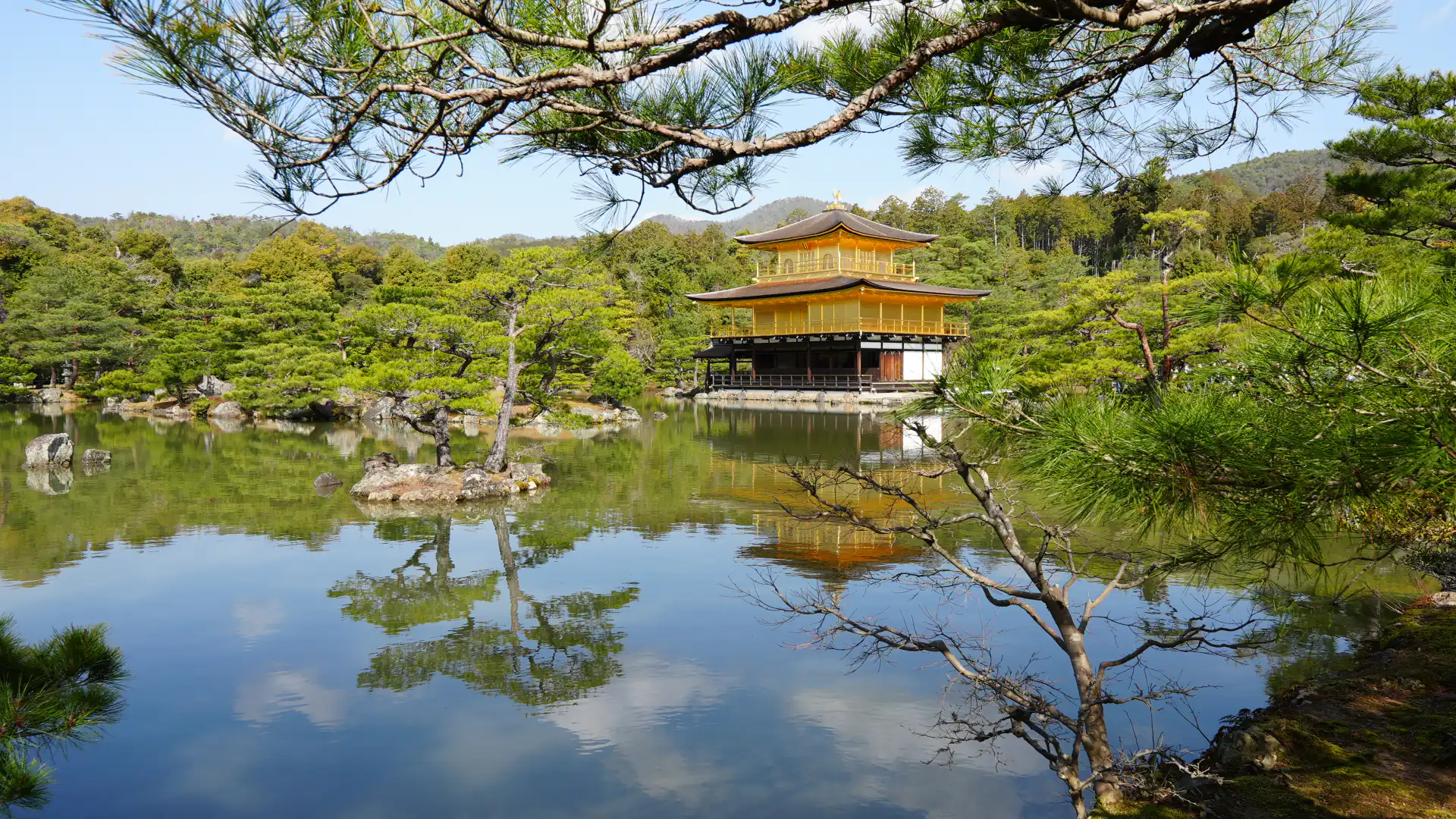
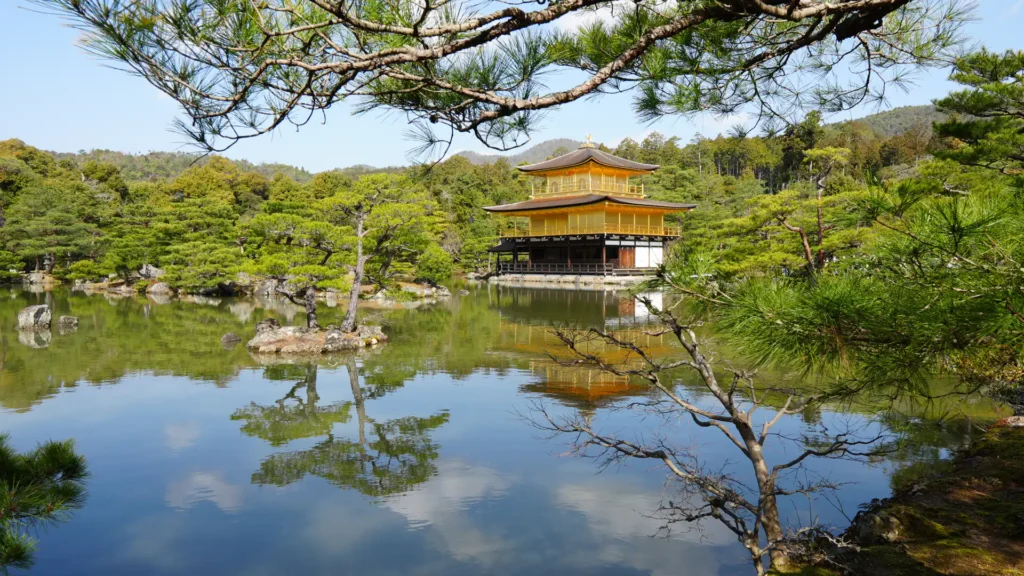
Kinkaku-ji is an extremely popular sight in Kyoto and Japan. We visited it while staying at Roku Kyoto Hotels and Resorts. We found the pavilion and landscape very beautiful, however the site was very crowded. In this post, we share our impression of Kinkaku-ji and visit tips to make the most of your time here.
Overview
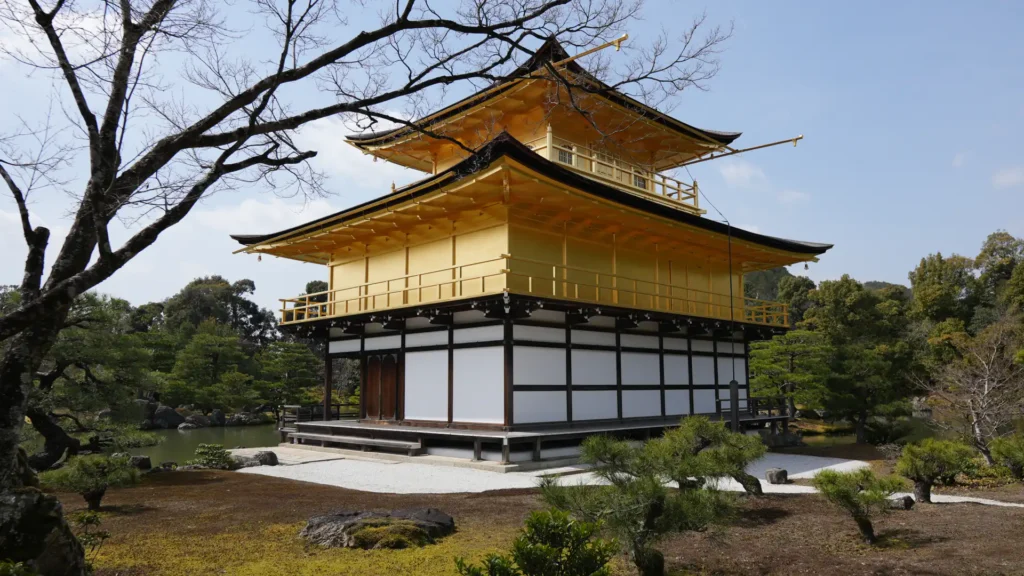
Kinkaku-ji is a Zen Buddhist temple in Kyoto. Originally constructed in 1399, it was burned down by arson and reconstructed in 1950. The building incorporates three distinct styles of architecture: the first floor shows shinden-zukuri style, reminiscent of Heian imperial aristocratic residential style; the second floor demonstrates buke-zukuri style, or warrior aristocratic style; the third floor is built in Chinese style, zenshū-butsuden-zukuri.
Perhaps the most interesting thing about the building is that the top two floors are covered entirely in gold leaf. The gold leaf is 0.5 micrometer thick, and in total it weighs 20 kg, which is worth approximately $1,666,357.10 USD. Gold was used as a symbolic act against demons and ill spirits, as well as the visual effect of reflecting the sun and the reflection created on the pond.
How to get to Kinkaku-ji
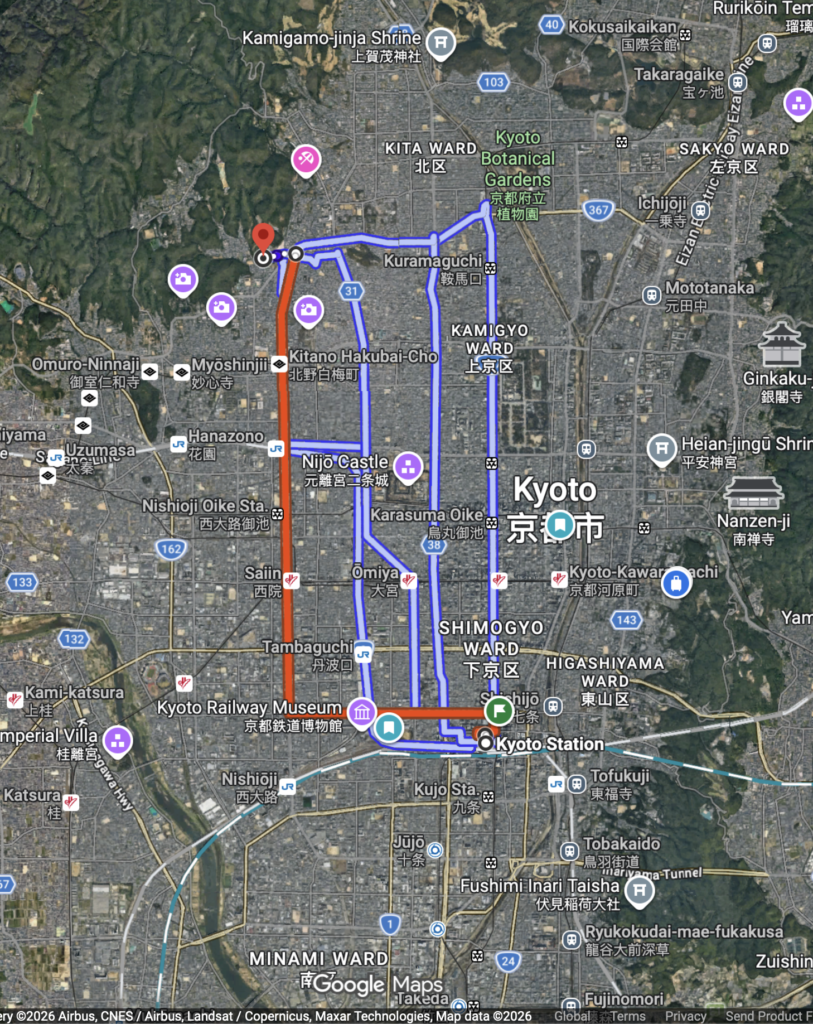
From Kyoto station, a taxi to Kinkaku-ji takes about 30 minutes and costs about US$25. Alternatively, you can take public transportation, using Karasuma train line and city bus. The journey takes about 35-45 minutes and costs approximately US$3.
Tips for visiting Kinkaku-ji
Kinkaku-ji is extremely popular, with over 5 million visitors annually. To put that into perspective, that’s 13,700 people per day on average. However, during peak times such as cherry blossom season, the number will certainly be many more.
To ensure a good visit, follow these tips:
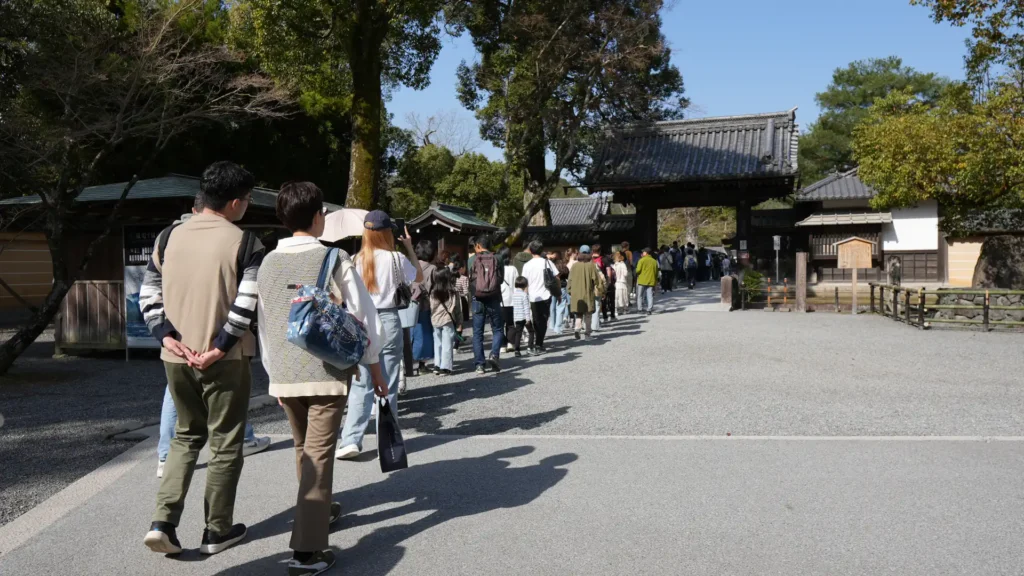
Arrive before the opening time at 9am, or later in the day (last entry 4:30pm, closing time 5pm). We arrived around 8:45am and there was already a long line.
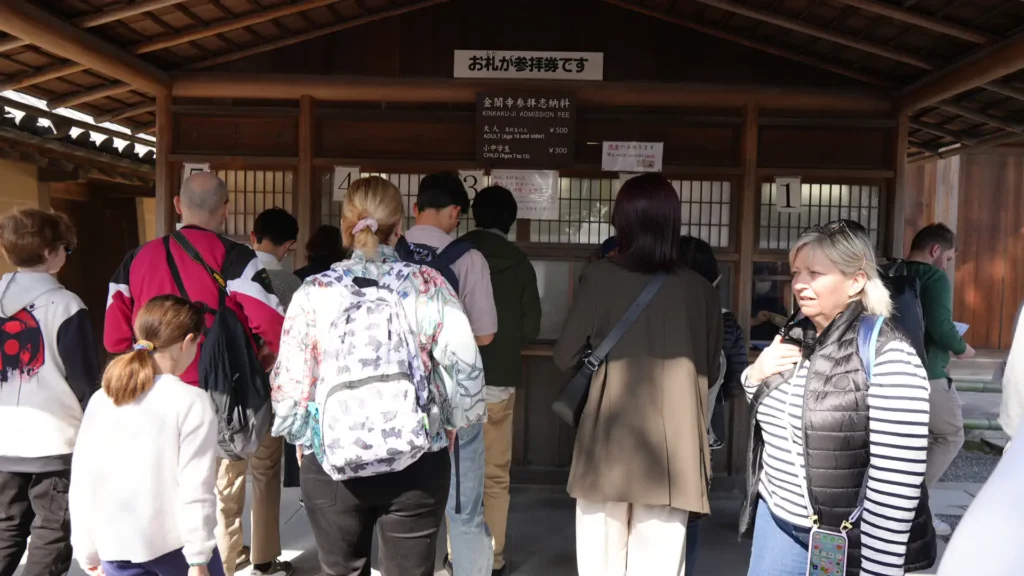
Have exact cash ready. There are no ATM machines nearby. The tickets can be paid only by cash, no credit or debit cards are accepted. Adult ticket is 500 yen, and children ticket is 300 yen. You might need more cash for souvenirs inside the complex.
The line is long but the staff is very efficient, so it moves quickly. Be ready to move with the flow. Do not block traffic.
Know what you want to see and where to go (see below)
What to see at Kinkaku-ji
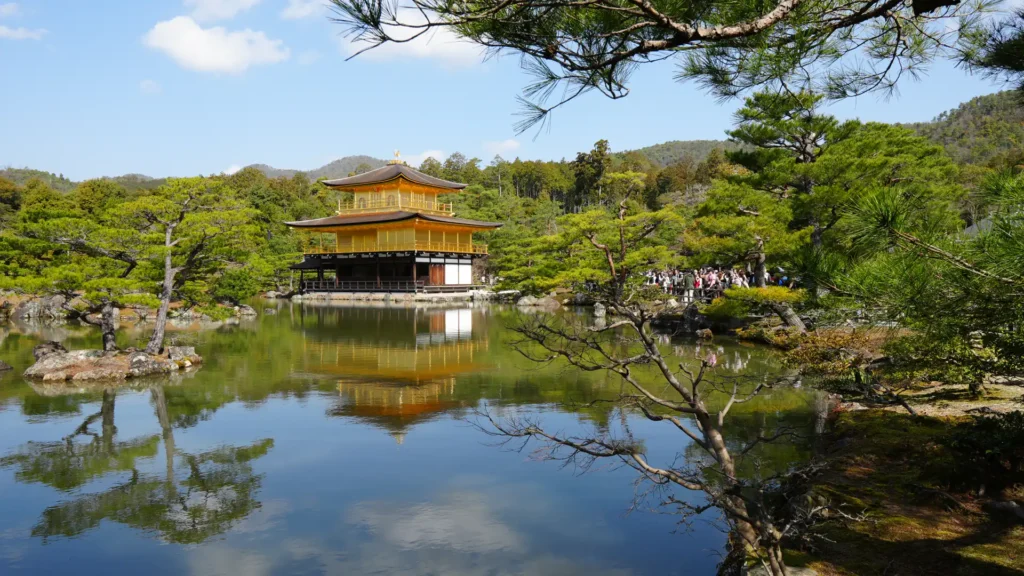
The obvious thing to see here is the Golden Pavilion. Not only is it beautiful, but the setting blends harmoniously into the surroundings. Despite how crowded it was, we found our experience to be worthwhile.
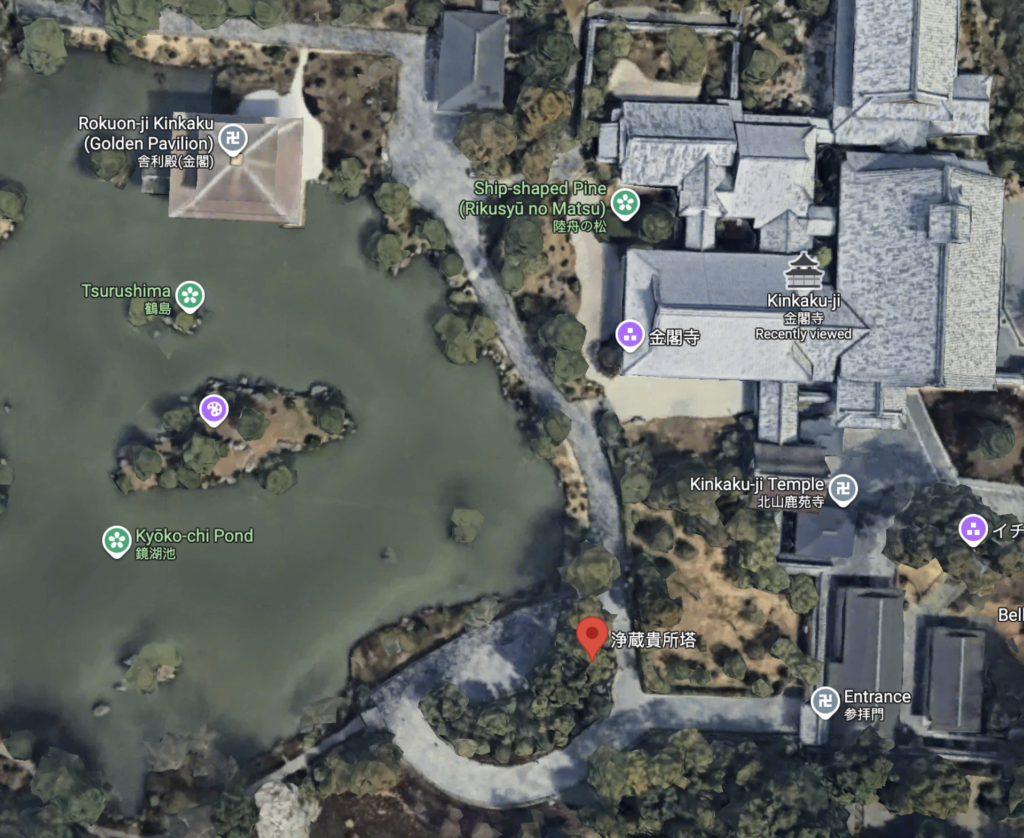
The Pavilion can be seen at any point along the path around the pond. However, there are two places where the sights are particularly impressive, in my opinion. The first view point is from the old pine tree at the corner of the pond (near the red mark in the map below).
From this perspective, the crowds along the path are obscured by the trees and bushes, while the Golden Pavilion is seen at its best angle.
For example, in the photo below, the crowd can be seen along the path on the right.
Simply move a bit towards the tree on the right, and the crowd becomes hidden by the tree branches.
The second view point is at the back of the temple. Just follow the path as it’s mostly a one way traffic, and you won’t miss it.
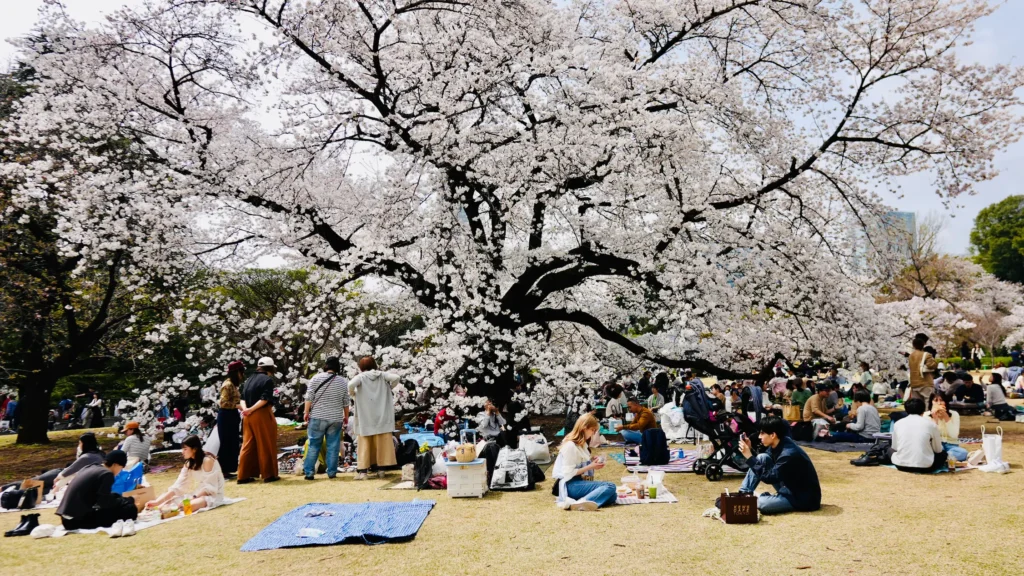
Cherry blossom is as synonymous with Japan as McDonalds is synonymous with America. As gateway to the vast majority of international visitors to Japan, Tokyo is not only an interesting megacity packed with beautiful sights and interesting things to see, do, and eat; this city is also blessed with numerous cherry blossom sights, some of the best in the whole of Japan. If you come to Tokyo between mid-March and mid-April, it would be a terrible mistake not to partake in the enormously popular activity of hanami. Literally translated as “cherry blossom viewing”, hanami is an opportunity to connect with nature, relax with friends and family, and be reminded of the fleeting beauty in the world.
But for would-be cherry blossom viewers from abroad, participating in hanami is not just simple as buying a flight ticket and showing up in Tokyo. From timing the peak bloom, which fluctuates every year, to scouting sightseeing locations, accommodations, and transportation, things can get complicated quickly.
This guide presents you with essential information so that you can plan your trip to Tokyo and enjoy cherry blossom at its peak. From different types of cherry blossom, to how to use the official blossom forecast, and what Japanese people do during hanami season, the information on this page will help you make the most of your money and time in Tokyo’s spring season.
Why is it important to know that there are different types of cherry blossom?
The vast majority of foreign tourists to Japan concentrate their visits during the Somei Yoshino cherry blossom period, which typically lasts from late March to early April. I believe this approach to planning is mistaken, because there are many cherry varieties in addition to Somei Yoshino, that are just as beautiful, but bloom at different times. Knowing this, you can choose to come after the peak tourist period, taking advantage of cheaper prices, less crowd, and better weather, while still enjoying the beauty of cherry blossoms.
When you come to Tokyo mid to late-April, you can expect to see peak blooms of late blooming varieties such as Double cherry (Yaezakura).
What you should know about Tokyo’s weather pattern
Understanding the weather pattern of Tokyo is important for two reasons:
You know what to expect around cherry blossom viewing experience
You know what to bring to dress comfortably
Here is a summary of typical weather pattern in Tokyo
Month
Avg High Temp
Avg Low Temp
Precipitation Trends
Mid-March
13°C (55°F)
5°C (41°F)
Transition from dry winter to scattered rain
April
19°C (66°F)
10°C (50°F)
Mild with occasional “flower-viewing” showers
Early May
23°C (73°F)
15°C (59°F)
Increasingly warm, often reaching 25°C+
*Data represents historical averages for Tokyo. Temperatures can vary significantly by year.
The “Temperature Rollercoaster”: March and early April are transitional. You may experience a warm, sunny afternoon (18°C) followed by a “return of the cold” (hanabie) where temperatures drop to 5°C at night. This volatility can pause or accelerate cherry blossom growth unexpectedly.
Sakura-ame (Cherry Blossom Rain): While spring is relatively dry, April often sees light, passing showers. Heavy spring storms or strong winds (haru ichiban) are “peak-killers” that can end the mankai (full bloom) period in just 48 hours.
Rapid Warming in May: By early May (Golden Week), the weather shifts toward an early summer climate. While comfortable, recent years have seen May daytime highs occasionally nearing 30°C (86°F), feeling more like summer than spring.
The period of comfortable spring weather in Tokyo is quite short, lasting just about 3-4 weeks from early April to early May. Additionally, evening temperatures can be quite cold. Regardless of cherry blossom peak time, mid-March to early April in Tokyo is characterized by highly variable weather. It is often chilly and damp with frequent, light showers. Statistically speaking, the chance of a “wet day” (at least 1mm of rain) is about 33–35%. Additionally, this is one of the cloudiest times of the year, with overcast conditions common even when it isn’t raining. This is another key reason why arriving a few days after beginning of April will maximize your chance of having both good show of cherry blossom (not just Somei Yoshino but the peak of yaezakura) and good weather.
Period
Average High
Average Low
Weather Characteristic
Early April
19°C (66°F)
10°C (50°F)
Stable but chilly evenings
Late April
21°C (70°F)
13°C (55°F)
Comfortably warm; peak greenery
Early May
24°C (75°F)
16°C (61°F)
Very mild; start of summer-like warmth
*Averages based on historical Tokyo climate data. Actual conditions may vary.
What are the best sites for enjoying cherry blossom in Tokyo?
Tokyo is a vast metropolitan area. Over 30 million people live here. The city is actually comprises of several smaller cities. Here I list the best sites for enjoying cherry blossom in Tokyo, using the following criteria:
The number of cherry trees planted
The number of cherry varieties planted
The size of the location relative to expected number of visitors (i.e. crowdedness)
Approximate distance to popular accommodation clusters
The Ultimate Guide to Hanami: How to Enjoy Japan’s Cherry Blossom Tradition
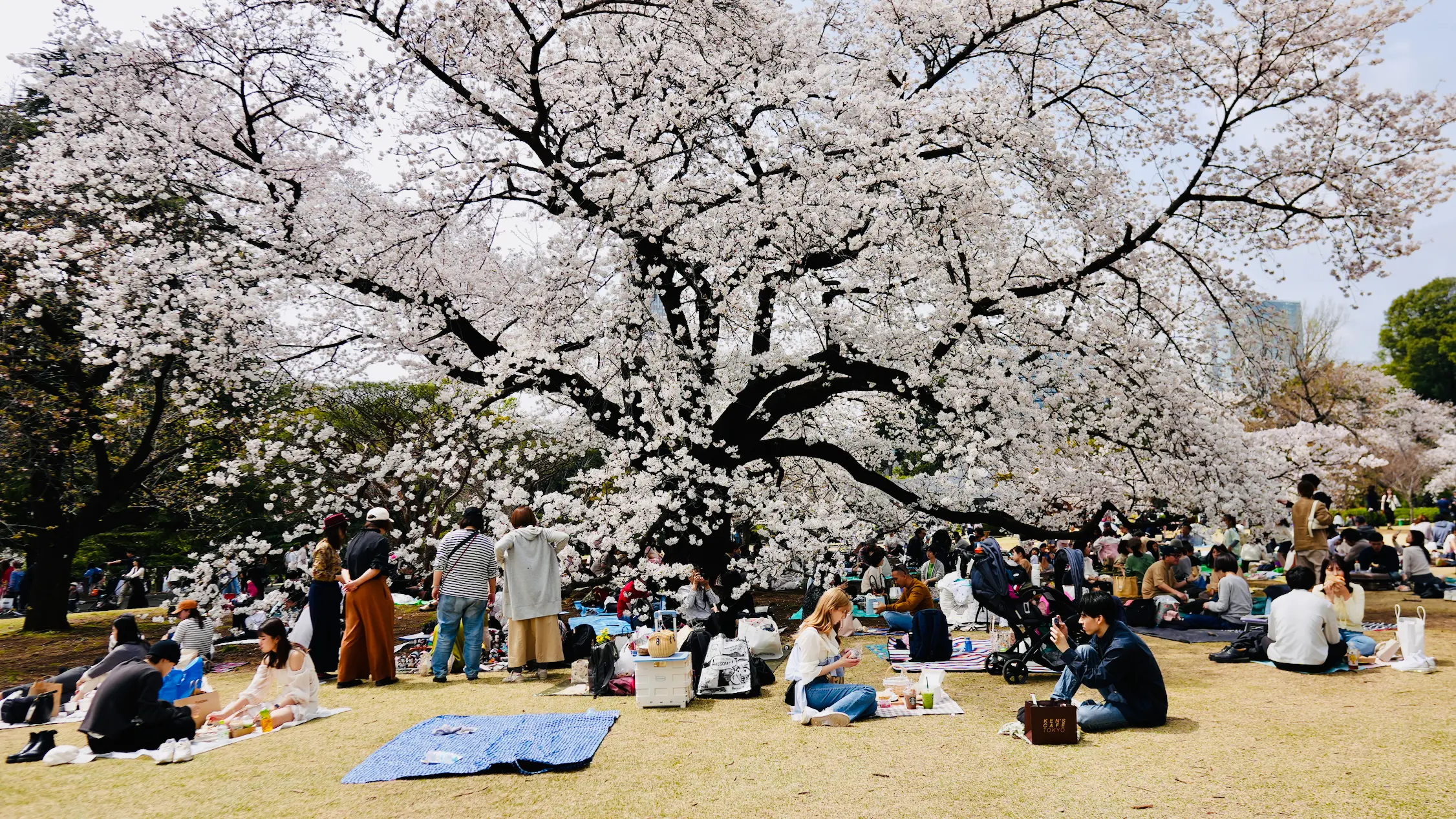
If you are planning a spring trip to Japan, there is one word you need to know: Hanami. Literally translating to “flower viewing,” Hanami is the centuries-old Japanese tradition of welcoming spring by enjoying the transient beauty of cherry blossoms (sakura).
After my 2024 “forecast fail” in Tokyo, I spent the following seasons learning the unwritten rules of this festival. To help you avoid the crowds and picnic like a local, here is everything you need to know about mastering the art of Hanami.
What is Hanami? More Than Just a Picnic
While it might look like a simple park outing, Hanami is a deep cultural celebration of mono no aware—the Japanese term for the beauty of impermanence. Because cherry blossoms only reach full bloom (mankai) for about a week, the festival is a reminder to cherish the present moment.
How to Plan the Perfect Hanami Party
To successfully host a cherry blossom party in popular spots like Shinjuku Gyoen or Ueno Park, you need to follow these three essential steps:
1. The “Blue Tarp” Strategy
In Japan, space is claimed using a blue plastic tarp. Pro Tip: One person from your group usually arrives early in the morning to “stake out” a spot. Always remove your shoes before stepping onto someone’s tarp—it is considered an extension of their home!
2. Essential Hanami Supplies
Seasonal Snacks: Look for Hanami Dango (pink, white, and green rice dumplings) and Sakura Mochi at local 7-Eleven or Lawson convenience stores.
Warm Clothing: Even if the sun is out, Tokyo evenings in late March are notoriously chilly. Bring heat packs (kairo) for when the sun goes down.
Garbage Bags: Most parks have strict “carry-in, carry-out” rules. Don’t be the tourist who leaves trash behind.
Top 3 Hanami Spots in Tokyo for 2026
If you want the best photos for your blog or social media, target these iconic locations:
Chidorigafuchi Moat: Rent a rowboat to float under tunnels of Somei Yoshino blossoms.
Meguro River: Famous for Yozakura (night-time cherry blossoms) illuminated by pink lanterns.
Inokashira Park: A more local, relaxed vibe in the trendy Kichijoji neighborhood.
The “Hanami Fail”: Common Mistakes to Avoid
The biggest mistake travelers make is touching the trees. Sakura petals are incredibly delicate; shaking a branch for a “snow” effect or climbing a tree is considered extremely disrespectful and can damage the blossoms for everyone else.
Cherry blossom season is the heart of Japanese tourism, driving a massive wave of international visitors and local celebration. Because the stakes are so high, various agencies invest heavily in complex models to provide the most accurate Japan cherry blossom forecast possible.
Predicting the exact “kaika” (flowering) and “mankai” (full bloom) is an immense scientific task. Forecasters must calculate dormancy breaking by analyzing autumn chill, winter cold spells, and the rapidly changing temperatures of early spring.
The Benchmark Tree Secret It is important to note that the official cherry blossom forecast from the Japan Meteorological Agency (JMA) specifically tracks only the Somei Yoshino variety. Furthermore, the forecast is based on a single “benchmark tree” in each city. For example, the Tokyo cherry blossom forecast relies entirely on a specific Somei Yoshino tree at Yasukuni Shrine.
Because weather events are unpredictable, relying purely on early forecasts can lead to major disappointment if you’ve booked your trip to Tokyo with the sole goal of seeing full bloom.
This post explains how to read cherry blossom forecast, the different botanical stages of cherry blossom, and examines the history of forecast accuracy, in order to derive a strategy for using the forecast effectively.
How to read cherry blossom forecast
The forecasts are published on Japan Meteorological Agency website: https://n-kishou.com/corp/news-contents/sakura/?lang=en
Each year, five forecasts are issued. The first is issued in December, followed by updates every few weeks as the agency incorporates temperature information as it becomes available. The last forecast is issued in March.
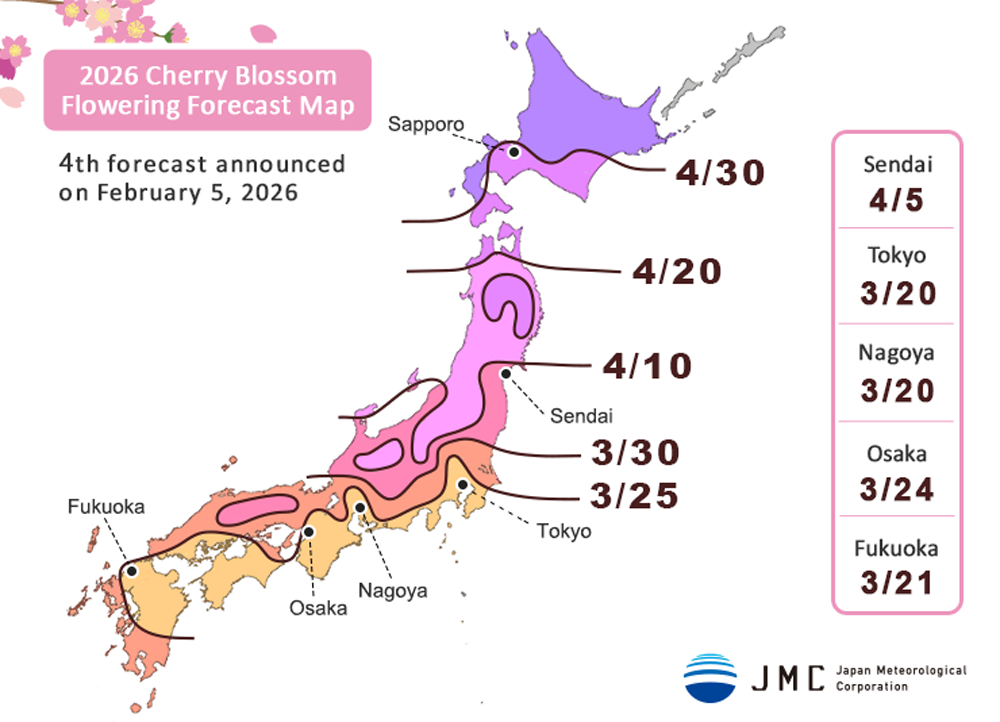
A typical forecast includes a map like this (Source: JMC)
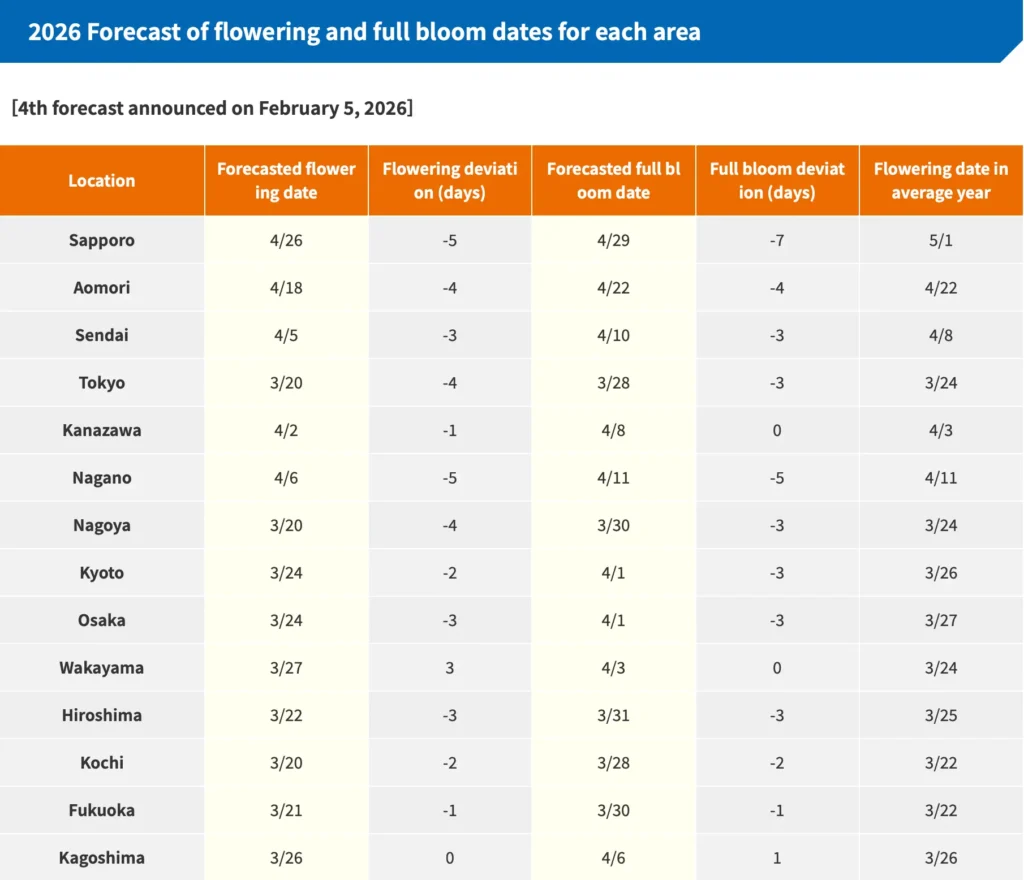
and a table like this
In the map, the dates shown are when the flowers are predicted to begin to open. This is called Kaika in Japanese. When the first 5 buds on a cherry tree open, the tree is said to have entered the Kaika period. The date of Kaika is shown in the “Forecasted flowering date” column in the table.
In the forecast table, the “Forecasted full bloom date” column shows the dates when at least 80% of the buds of the trees have opened. Full bloom is called Mankai. The visual effect of Mankai is clouds of flowers. It is a dreamy sight no pictures can capture.
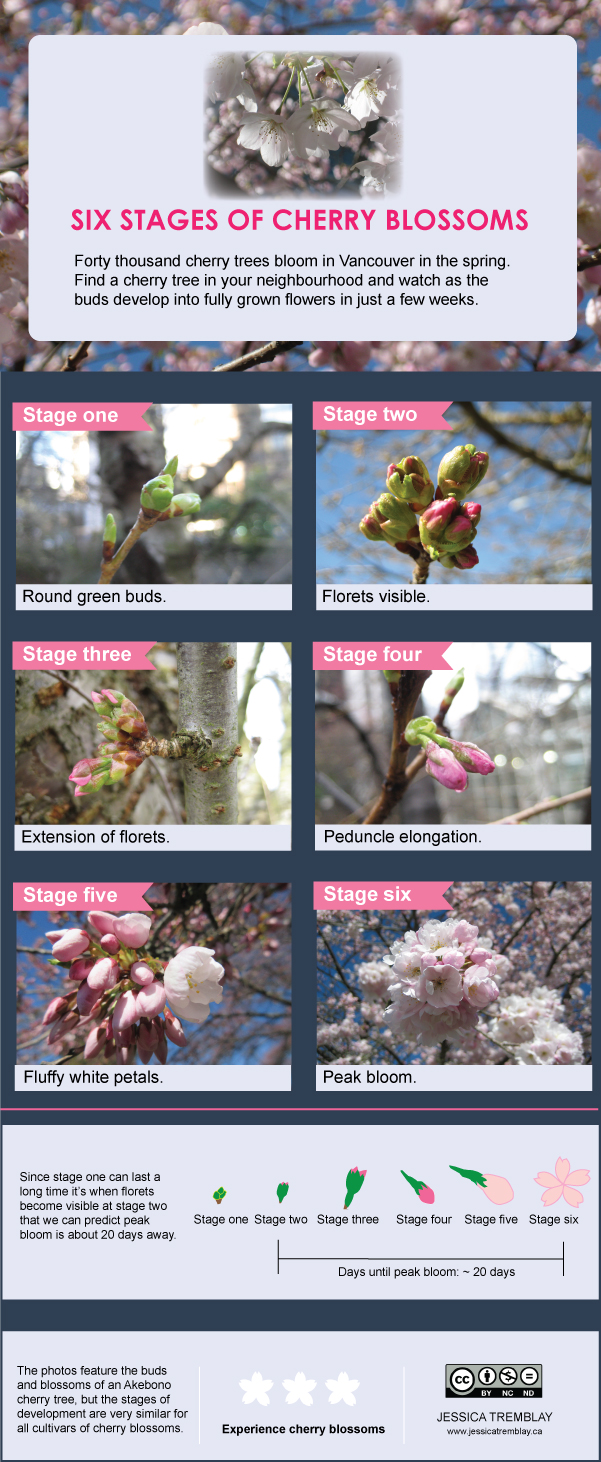
Cherry blossom stages
Here is a serious botanically accurate description of cherry blossom stages (Source: Vancouver Cherry Blossom Festival)
You’ll notice that it takes about a week for the transition from Kaika to Mankai. For example, in Tokyo, Kaika is forecasted on 3/22, and Mankai is forecasted on 3/29. In Kyoto, Kaika is forecasted on 3/25, and Mankai is forecasted on 4/2.
Mankai period is short. Heavy rain and wind might wipe out the petals and shorten Mankai to just a few days, while prolonged period of sunshine and calm weather helps extend Mankai to a week.
Following Mankai, the petals start falling off en-mass. This causes the flower blizzard phenomenon, Hanafubuki, when millions of cherry blossom petals fly around in the wind. This is an especially beautiful time.
The entire blooming period, from when the buds open, until the petals have completely fallen off, is 10-14 days.
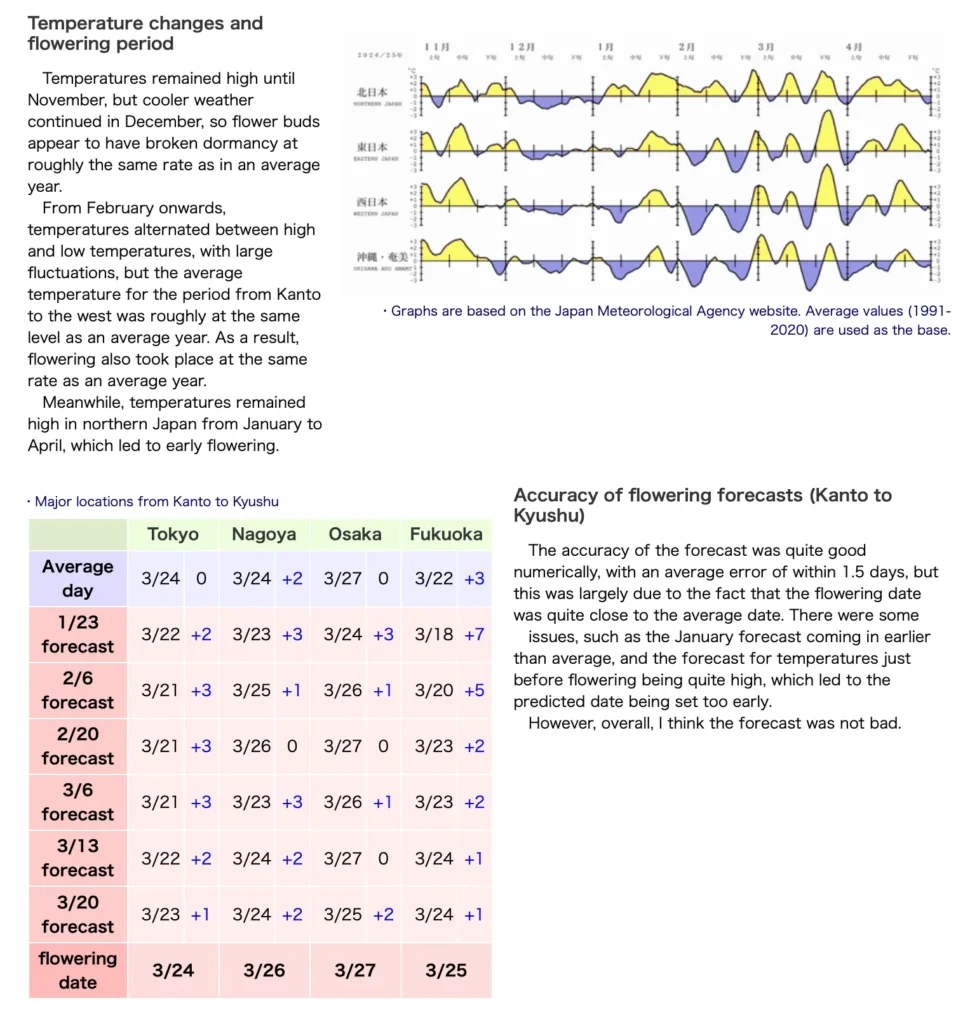
Comparing the forecast history with actual blooming dates
The website www.sakura-weathermap.jp keeps records of past forecasts as well as actual blooming time, going back to 2010. The website is in Japanese, but for English speakers, here’s a link to the translation provided by Google.
The website notes the weather pattern and temperature changes preceding cherry blossom season each year. Then, it compares the forecasted flowering dates with the actual flowering date.
Based on these data, I have compiled the following table of “Forecasted Flowering Date” vs. “Actual Flowering Date” and “Actual Mankai Date” for Tokyo:
Year
1st Forecast (Jan/Feb)
Final Forecast (Late March)
Actual Bloom Date
vs 1st Forecast
vs 2nd Forecast
Actual Mankai Date
Accuracy Notes
2025
March 21
March 21
March 24
+3
+3
March 30
Early heat led to very early initial projections.
2024
March 19
March 24
March 29
+10
+5
April 4
Forecast was 5-10 days early due to late March cold snap.
2023
March 22
March 16
March 14
-8
-2
March 22
Record March heat caused bloom to beat all forecasts.
2022
March 23
March 21
March 20
-3
-1
March 27
Generally accurate; slightly earlier than expected.
2021
March 18
March 15
March 14
-4
-1
March 22
Tied record for earliest bloom; heat surpassed models.
2020
March 19
March 16
March 14
-5
-2
March 22
Record early bloom; forecasts adjusted late.
2019
March 22
March 21
March 21
-1
0
March 27
Highly accurate year with stable temperatures.
2018
March 23
March 19
March 17
-6
-2
March 24
Earlier than forecast due to a heat wave.
2017
March 24
March 22
March 21
-3
-1
April 2
Slow start followed by quick progression.
2016
March 22
March 21
March 21
-1
0
March 31
Forecasts captured the timing well.
2015
March 26
March 24
March 23
-3
-1
March 29
Slightly earlier than initial models predicted.
2014
March 28
March 26
March 25
-3
-1
March 30
Regular spring progression; accurate final updates.
2013
March 25
March 18
March 16
-9
-3
March 22
Unexpectedly early; forecasts missed by a week.
2012
March 26
March 30
March 31
+5
+1
April 6
Late bloom due to cold winter; forecasts late.
2011
March 25
March 27
March 28
+3
+1
April 6
Delayed slightly by cool March air.
2010
March 22
March 22
March 22
0
0
April 1
JMA’s final year; perfectly accurate.
*Table scrollable horizontally on mobile. Data compiled from historical JMA and WeatherNews reports.
Here are some insights from this table: – Average Date: The historical average for Mankai in Tokyo is March 31. – Volatile Timing: The dates have ranged from as early as March 22 (2020, 2021, 2023) to as late as April 6 (2011, 2012). – Impact of Global Warming: In recent years (2020–2025), the bloom has tended to occur earlier than the long-term 30-year average. But in the past two years, the bloom have occurred later than forecasted.
Strategies for using the forecast
The most visually impressive sights are Mankai and Hanafubuki. Therefore, when using the official cherry blossom forecasts to plan your trip, focus on the “Forecasted full bloom date”. You don’t want to arrive on the “Forecasted flowering date” only to find out only a few buds have opened!
If you’re planning to be in Tokyo for just a few days and still want to see cherry blossom, then it would be a good idea to arrive a bit later than the “Forecasted full bloom date”. The reason is that you will have a high likelihood of seeing peak bloom as well as flower blizzard. If you are staying in Tokyo for 1-2 week, then arriving a bit later will give you an opportunity to see the late-blooming cherry varieties (yaezakura). (Quick tip: hotels rate after the Somei Yoshino peak bloom are often cheaper.)
Of course, if you prefer seeing the peak bloom of the Somei Yoshino, which is undoubtedly beautiful, then arriving a bit earlier than the “Forecasted full bloom date” would be recommended.
When I planned my first trip to Japan in 2024, I followed the official Japan Meteorological Agency’s cherry blossom forecast religiously. Big mistake! The forecast was off by a week, and I landed in Tokyo to find bare branches instead of the pink paradise I expected.
I had fallen into the “cherry blossom disappointment trap” because I didn’t realize there are over 600 varieties of cherry blossoms in Japan, and they don’t all bloom at once. While the famous Somei Yoshino gets all the press, the total blooming season in Tokyo actually spans 8 weeks – from early March to early May.
If you want to avoid my mistake, you need to know which variety is blooming when you land. Here is exactly what I wish I knew then: the 10 most beautiful and popular Japanese cherry blossom varieties to help you plan the perfect spring trip.
What are the most popular and beautiful cherry blossom varieties in Japan?
Somei Yoshino
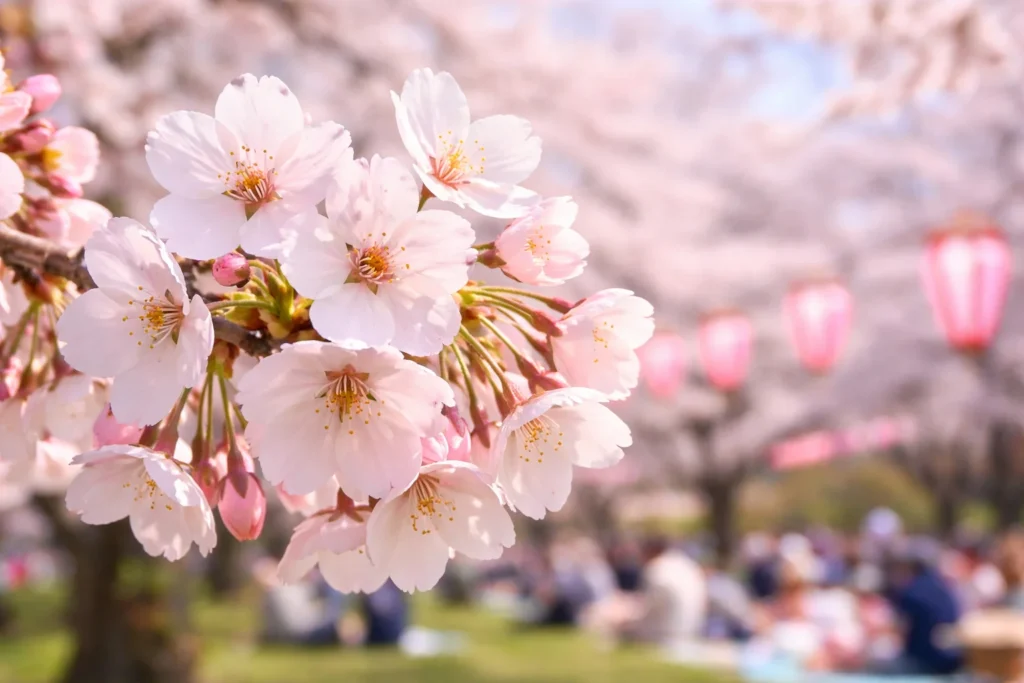
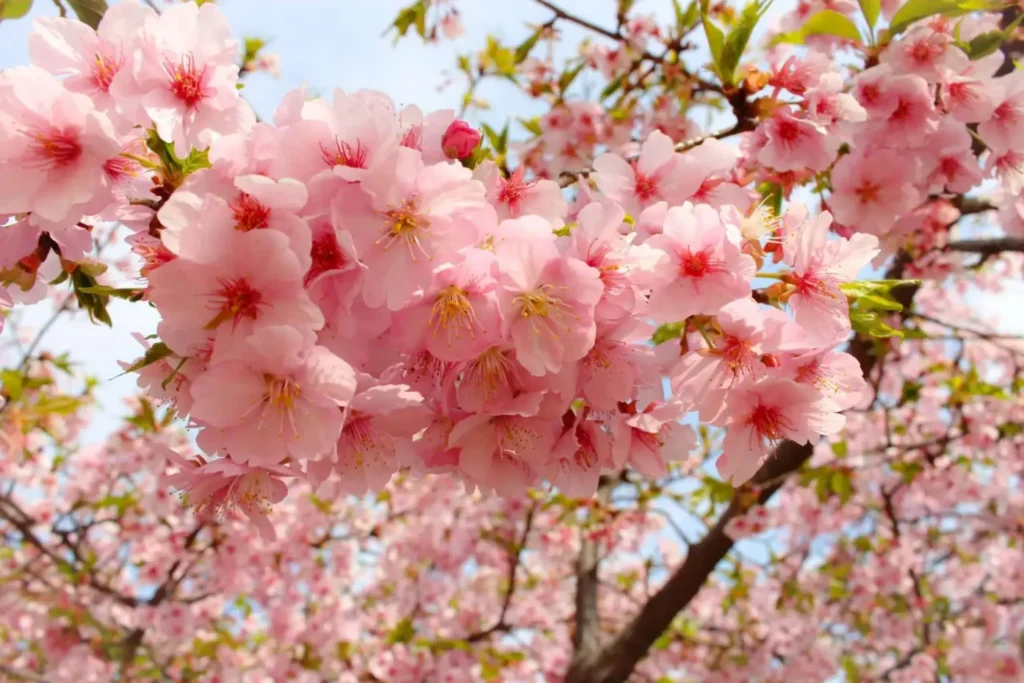
The most popular type of cherry blossom in Tokyo is Somei Yoshino. The blooms of Somei Yoshino have pale pink, almost white five petals that bloom in clusters. Flowers appear before the green leaves, creating a cloud-like effect. This cherry variety is a rather recent development, appearing only since the mid-19th as a hybrid of two cherry varieties – Oshima-zakura and Edo-higan. It was first developed in Somei village, modern-day Toshima city in Tokyo. As such, Somei Yoshino is native to Tokyo.
Because it grows much faster than other varieties and is very beautiful, Somei Yoshino accounts for approximately 70% to 80% of all cherry trees in Japan. In Tokyo, they are found in great numbers in Ueno Park, Chidorigafuchi (the moat around Imperial Palace), Shinjuku garden, and along Meguro River, among other sites.
Interesting fact: Every Somei Yoshino tree is a genetic clone of a single ancestor. This tree can’t reproduce by seed. This makes them incredibly uniform, meaning all trees in a park will bloom at the exact same time, creating the “cloud-like” effect everyone loves.
Somei Yoshino typically bloom between late March and early April, with the peak (full) bloom lasting about one week.
Shidarezakura (Weeping Cherry)
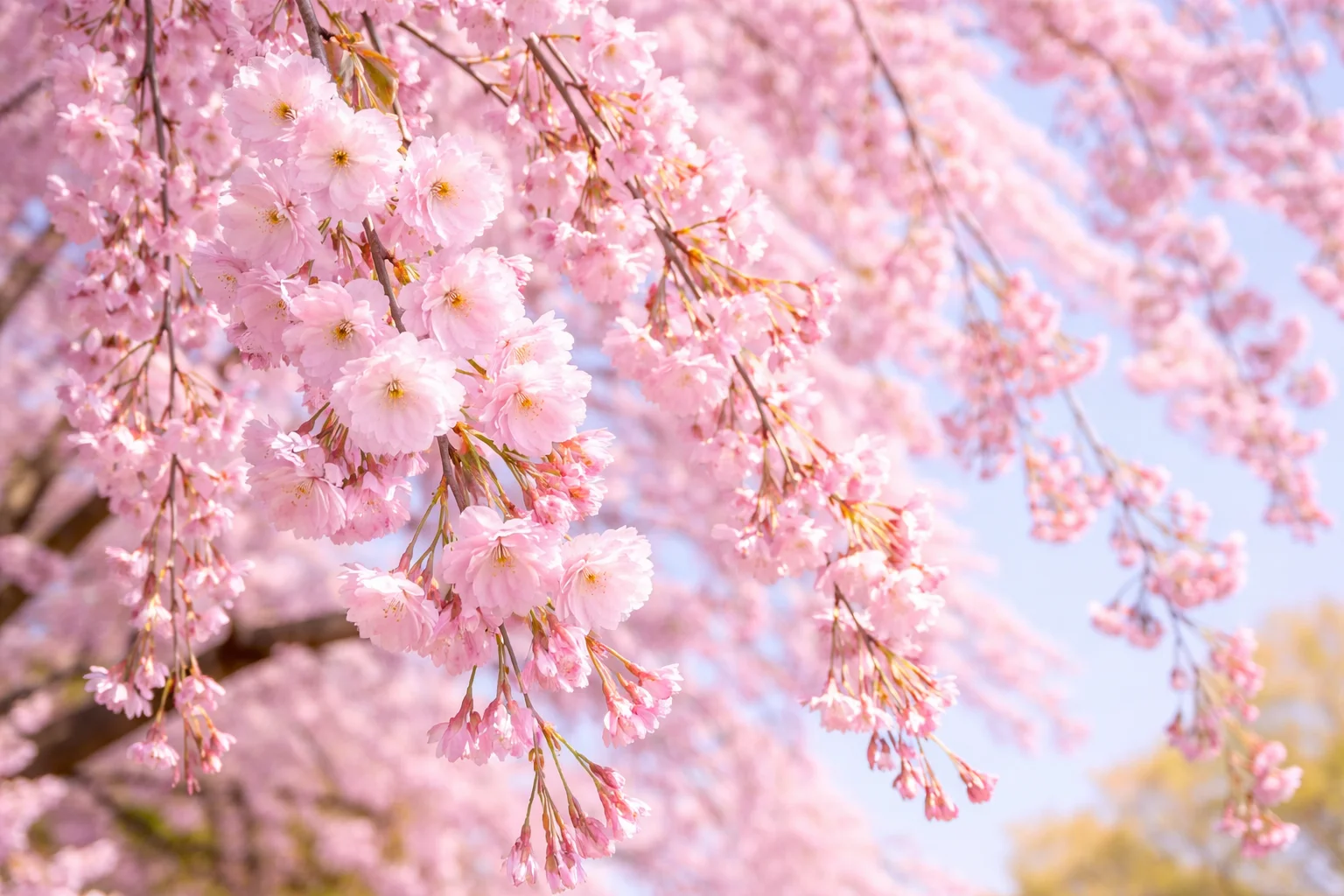
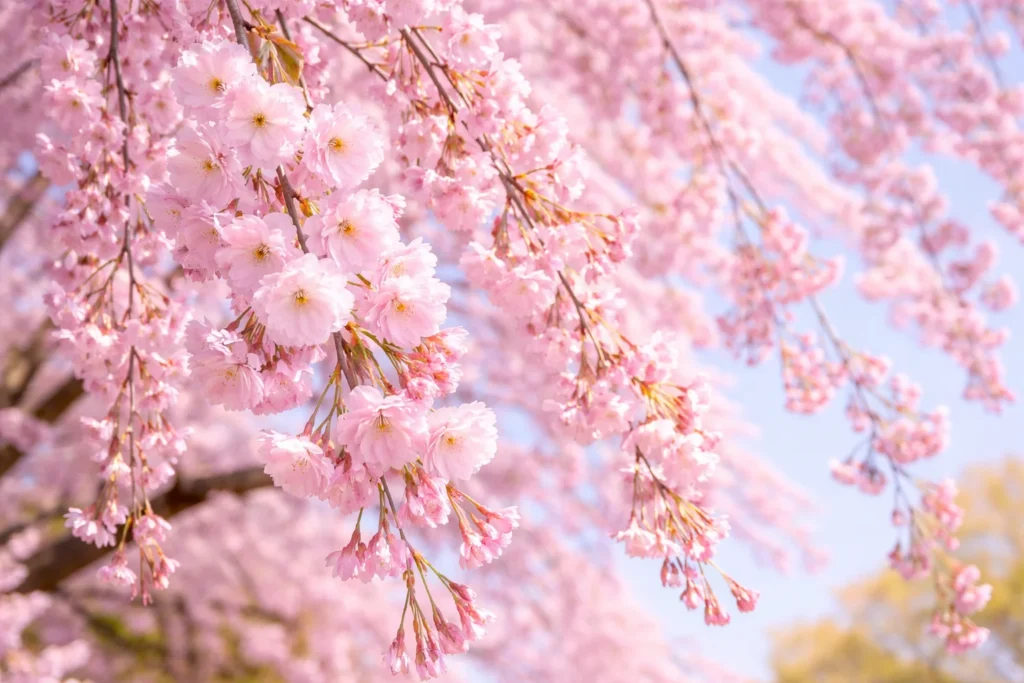
If Somei Yoshino gives viewers the impression of a cloud of flowers, then Shidarezakura impresses admirers with its waterfall-like drooping branches full of blooms. The flowers can be single (5 petals) or double (more than 5) and vary from white to deep pink.
Shidarezakura is a cultivar of the ancient Edo-higan species, with a history of appreciation dating back to the Heian period.
In Tokyo, notable specimens of Shidarezakura are at Rikugien garden, Shinjuku garden, and KOishikawa Korakuen. However, this type of cherry blossom can be found throughout the city.
The blooming period of Shidarezakura is often a few days before Somei Yoshino.
Yamazakura (Mountain Cherry)
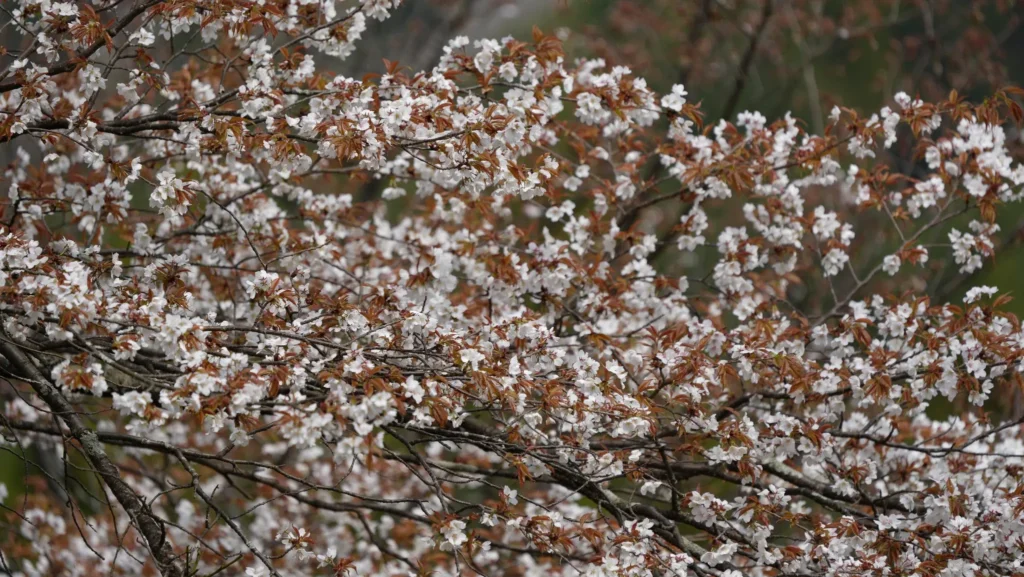
This is a wild species, with five small, light pink petals. Unlike Somei Yoshino, its blossoms and tender yound reddish-bronze leaves develop simultaneously.
As one of Japan’s most common wild cherry species, Yamazakura was celebrated in classical literature like The Tale of Genji.
These trees are often found in more natural or historic parks like Shinjuku Gyoen.
The blooming period is similar to Somei Yoshino, late March to early April.
Kanzan
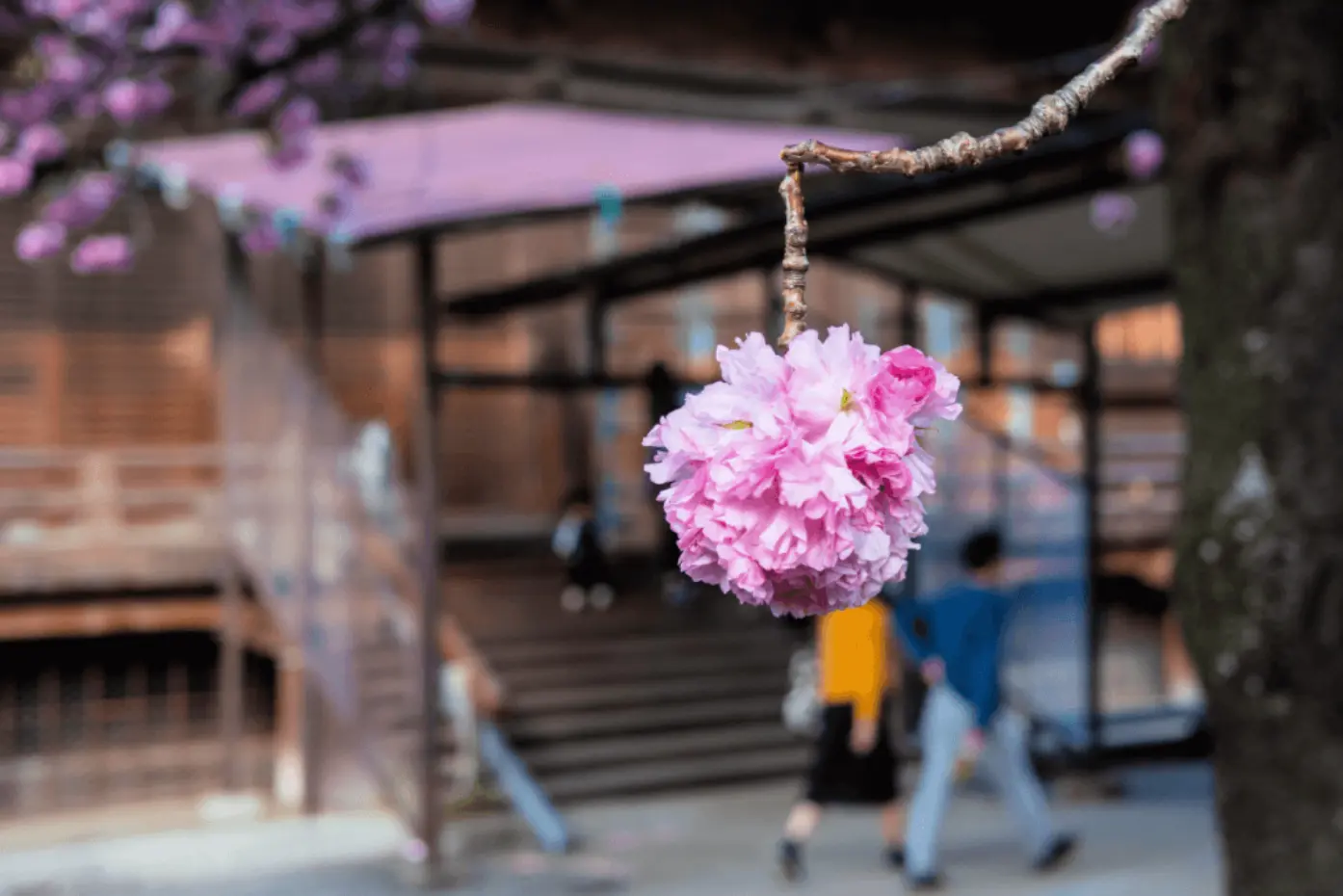
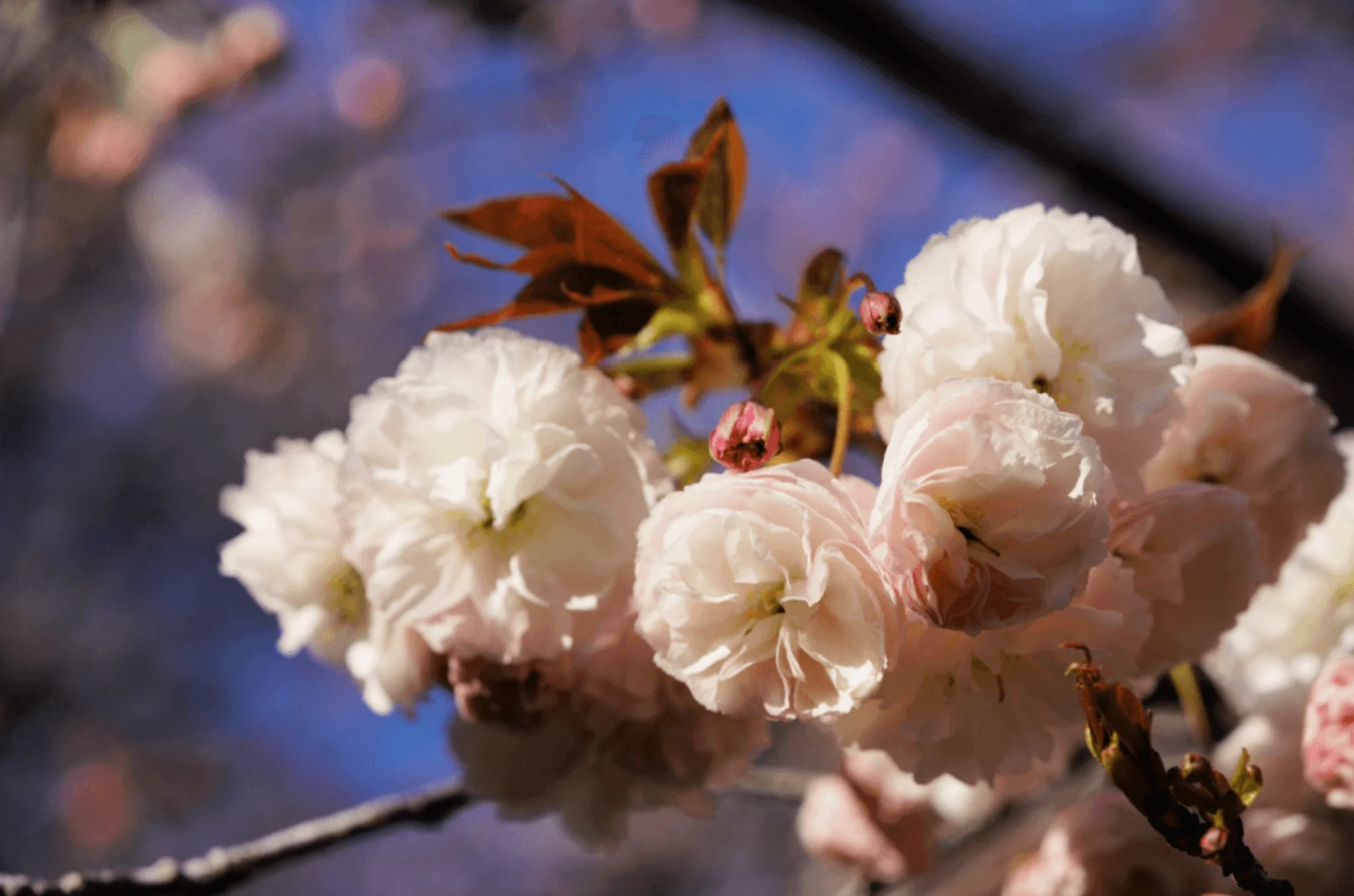
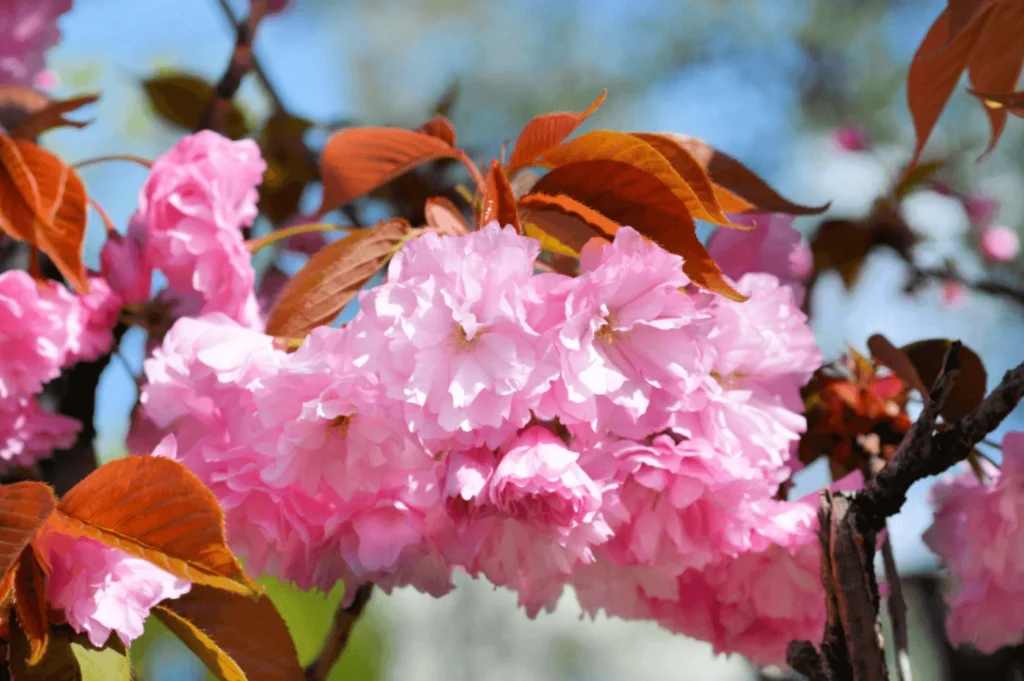
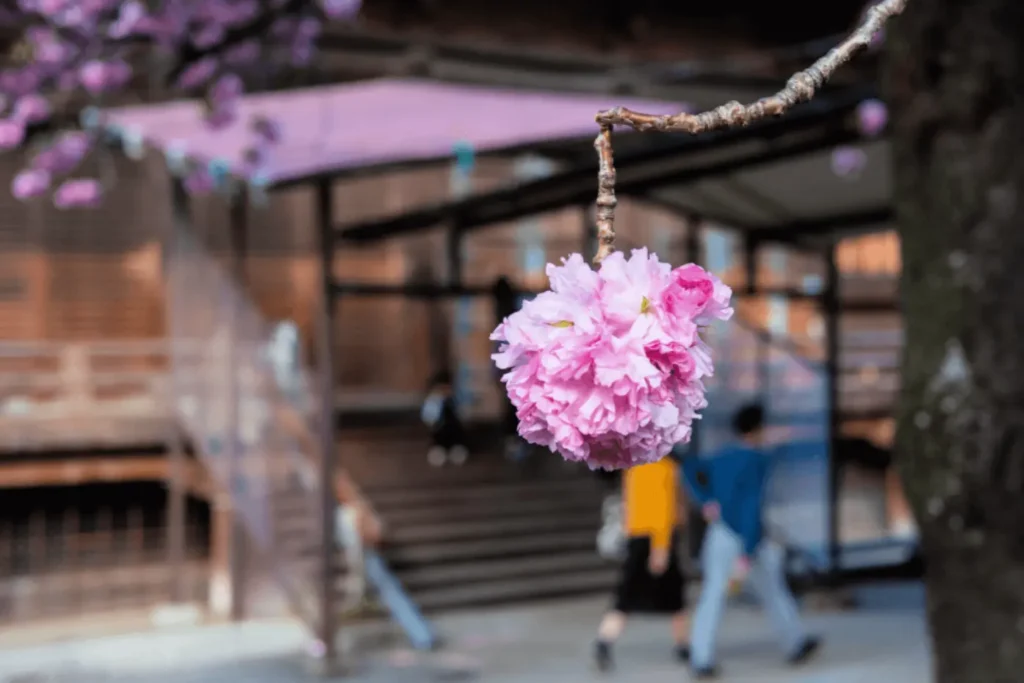
In Japanese, yaezakura means multi-petal (i.e. double) cherry blossom. The Kanzan variety is one of the most common yaezakura types. Each large, dense bloom features 30 to 50 vivid pink petals. The blooms are accompanied by coppery young leaves. Because the flowers are heavy, they hang in drooping clusters.
Kanzan cherry is abundant in large, curated gardens such as Shinjuku Gyoen National Garden and Ueno Park.
Kanzan is a late bloomer compared to Somei Yoshino. While Somei Yoshino blooms from late March to early April, the bloom period of Kanzan cherry is mid to late April.
Kikuzakura
Kikuzakura, or “chrysanthemum cherry,” is a distinct, late-blooming Japanese cherry cultivar known for its exceptionally multi-petalled, pink, pom-pom-like flowers. Each blossom features 80 to over 100 petals and appear alongside green leaves.
The trees are typically small, with a narrow and upright habit, becoming more open and speading with age.
Interesting fact: the Kenroku-en Kikuzakura in Kanazawa is a specific, rare, second-generation variety with up to 300 petals. It is designated as a natural monument.
Kiuzakura blooms the latest compared to Somei Yoshino, from late April to early May.
Kawazuzakura
Kawazu-zakura has large, deep pink petals. So the shape of the flower somewhat resembles Somei Yoshino, but the color is much more vibrant.
This variety originated in Kazawu Town on the Izu Peninsula.
In Tokyo, it is scatter in various city parks and along residential canals, such as Yodo Canal.
This is an early bloomer compared to Somei Yoshino, with flowers appearing from late February to mid-March in Tokyo.
Ichiyo
A type of yaezakura, Ichiyo blossoms have about 20 light pink petals per flower, giving the bloom a very full, fluffy appearance. The fresh leaves are green when the flowers emerge. A key characteristic is the single pistil in the center of the flower that resembles a leaf tip (“ichiyo” means “one leaf”).
Ichiyo is a popular Sato-zakura (village cherry) cultivar prized for its ample blossoms.
It is commonly planted in large parks and gardens, especially well-known in Shinjuku Gyoen.
Ichiyo is a late bloomer compared to Somei Yoshino. The blooming period of Ichiyo is mid to late April, consistent with other yaezakura varieties.
Fugenzo
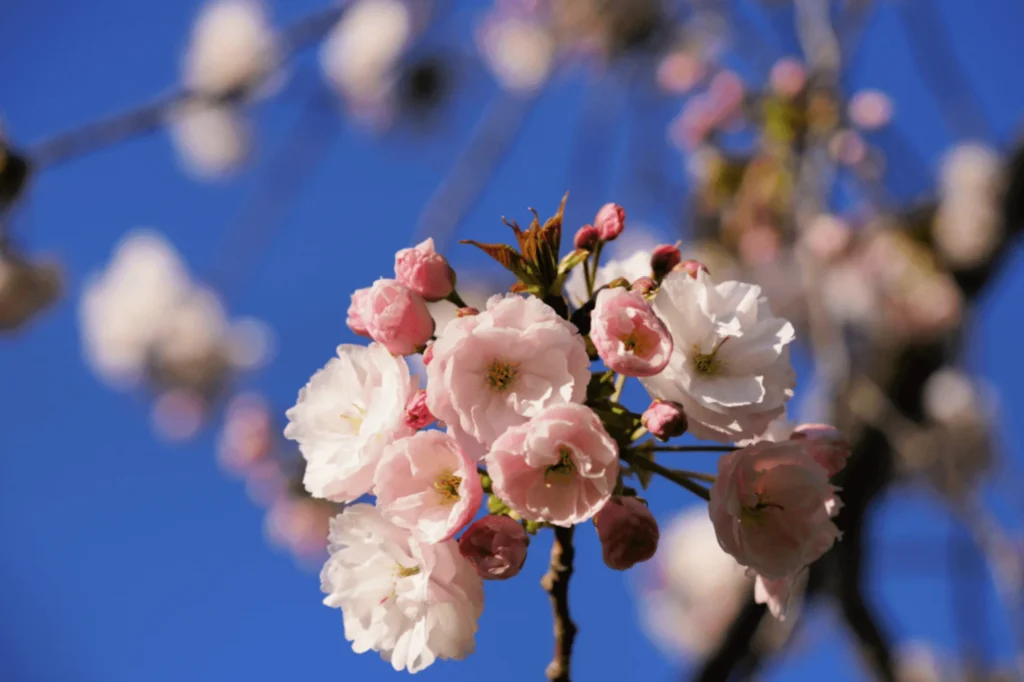
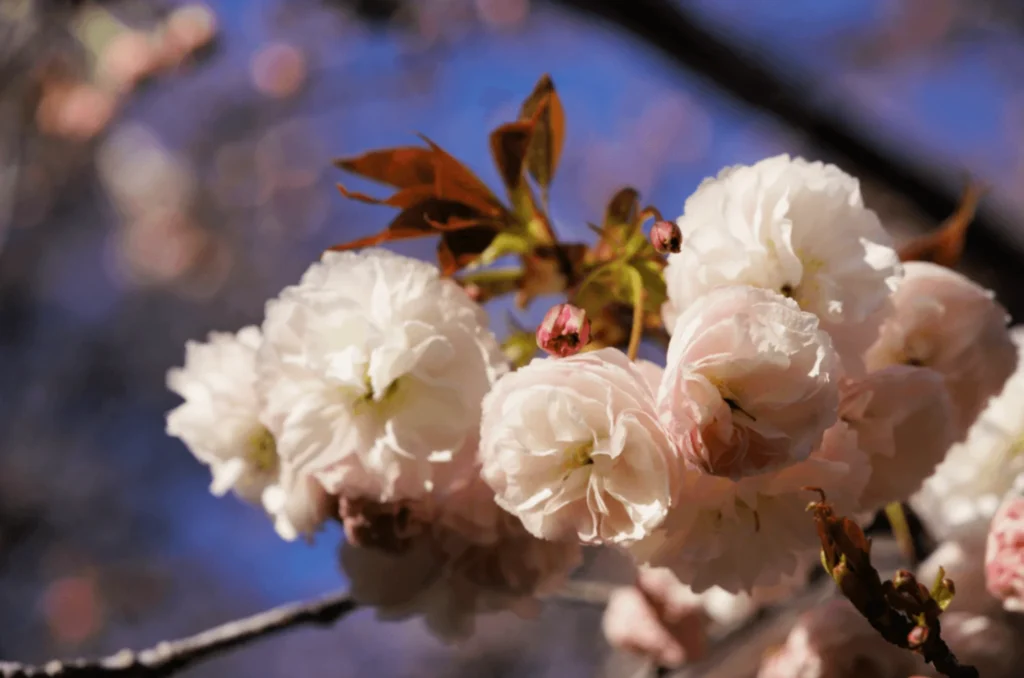
A type of yaezakura with 30 to 40 petals per blossom, the flowers of Fugenzo start white to slightly pink when they first open, and gradually deepen to a darker pink as they mature. The young leaves are copper brown.
The name is as interesting as the flower. It is named after the Fugen Bodhisattva (Samantabhadra), who is often depicted riding a white elephant. It is said to reference the shape and color of the blossom when fully open (but I struggle to see the similarity).
It is found in botanical gardens and major parks, such as Shinjuku Gyoen.
As a yaezakura, Fugenzo blooms mid to late April, after Somei Yoshino flowers have fallen.
Kanhizakura (Winter Cherry)
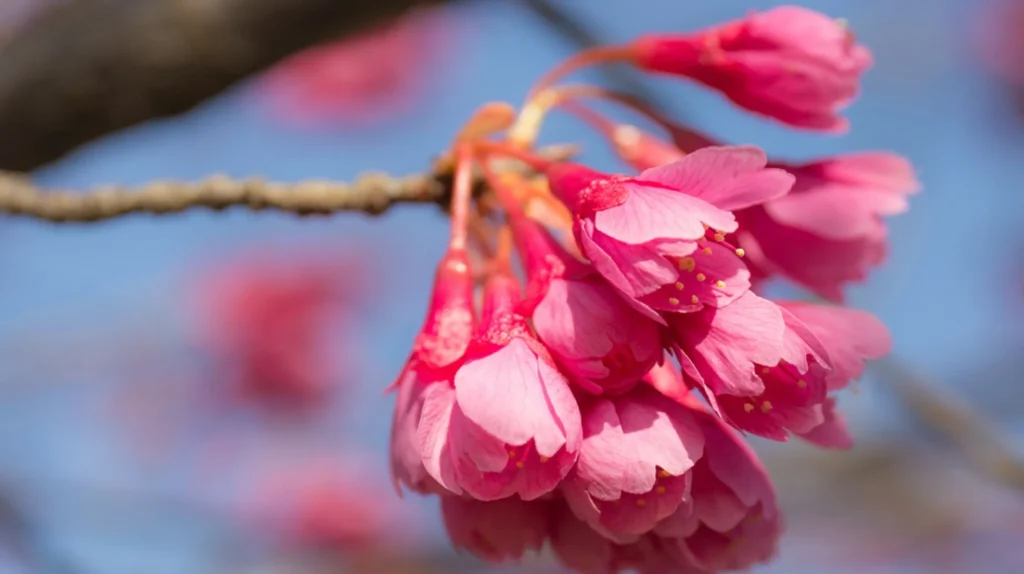
These flowers don’t look like typical cherry blossom. They have dark pink, bell-shaped flowers that hang downwards and do not open completely.
Kanhizakura is native to Taiwan and Okinawa, in much more southern latitude than Somei Yoshino’s. As a result, it is more common in southern Japan, but can still be found in Tokyo parks and botanical gardens.
Compared the blooming period of Somei Yoshino, Kanhizakura blooms very early, typically mid to late March.
Ukon
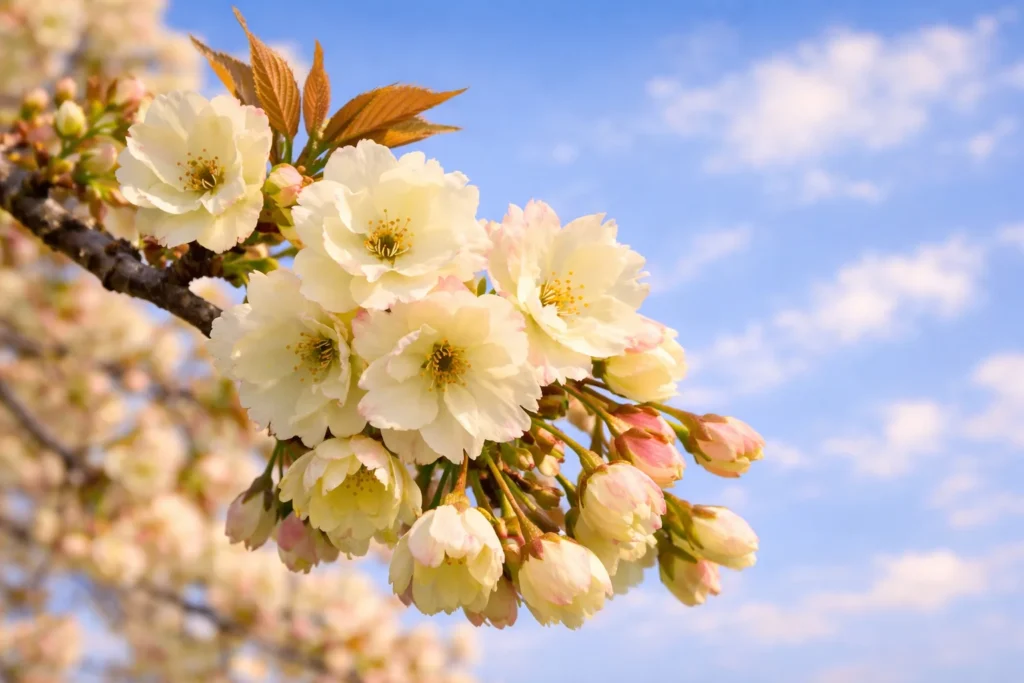
A unique variety with yellowish to pale green blooms, Ukon is a yaezakura. Each flower has 10 to 20 petals. Young leaves emerge alongside the blooms and have coppery hue.
As a yaezakura, Ukon is a late bloomer, with blooming period from mid to late April.
Planning Your Trip: Why Variety Timing is Everything
Why is it so critical to understand the blooming times of different Japanese cherry blossom varieties?
Most travelers rely solely on the Somei Yoshino forecast, unaware that it only tracks a single species. By limiting yourself to that narrow window, you risk missing out on the spectacular 8-week season that Tokyo actually offers.
When planning your spring trip to Japan, remember to balance the bloom forecast with these four factors:
Lower Prices: Early March or late April can save you hundreds on flights.
Accommodation Availability: Booking outside the “peak” week opens up better boutique hotels.
Crowd Control: Popular spots like Shinjuku Gyoen are far more peaceful during the Yaezakura (double-blossom) bloom.
Weather Stability: Late April often brings milder, more reliable spring weather than the “chilly” starts of March.
Don’t let a single forecast dictate your trip. Whether you arrive in early March for the Kawazu-zakura or late April for the lush double blossoms, Japan’s cherry blossom season is much longer and more rewarding than the travel brochures suggest.